I am learning flutter from JustAcademy, They provide very much great environment where people gather and work simultaneously. totally project based training institute.
MOHD ABU BAKAR ANSARI
Flutter Developer
Awesome Experience. I am a Front-end Web Designer working at Star India for 3 years now. I applied for Full-stack development and my experience has been phenomenal & they really do help with placements exceptionally. Thank you Roshan sir so much.
A practical, mentor guided path for Delhi learners who want to go from Java basics to job ready Spring Boot skills
If you have ever wondered why so many job descriptions in Delhi, Gurugram and Noida quietly list the same few lines, the answer is simple. Companies building banking platforms, travel portals, e-commerce engines and government facing systems keep reaching for the same toolkit, and the backend developer skills they ask for almost always begin with Java and end with Spring Boot. It is not a trend that arrived last year. It is a habit the industry has refused to break, and in 2026 it is stronger than ever.
This guide is written for people who live and work around Delhi and the NCR and want a straight, honest path into that world. If you prefer to learn with a guide beside you instead of piecing together random videos, the Full Stack Java Developer course in Delhi is built around live online, instructor led and mentor led sessions, and you can register for a free demo class to see how a session actually feels before you commit to anything.
Now let us get into the real work. Over the next several sections we will walk through what a Spring Boot developer actually does, which skills matter, in what order to learn them, how long it realistically takes, and where the jobs are. Think of this as a conversation with a senior colleague who has watched many beginners succeed and many others stall, and who wants you to land in the first group.
Why Spring Boot Still Runs the Backend World in 2026
What Changed in the Spring Ecosystem Recently
The Spring ecosystem has not stood still. Recent Spring Boot versions expect modern Java, move from the old javax packages to the jakarta namespace, support virtual threads for handling huge numbers of concurrent requests, and make native image builds far more practical for fast startup. Observability through Micrometer and Actuator is now built into the way applications are written rather than bolted on later.
What this means for you is that the framework you learn today is lighter, faster and more cloud friendly than the one your seniors learned. Older material that still talks about Spring 4 style XML configuration is useful only as history. If you are following an outdated tutorial, you may spend weeks learning patterns that modern teams quietly retired. This is one of the quiet traps of self study, and it is the reason a current, mentor checked syllabus matters so much.
Another change is that artificial intelligence has reached the Java world. Projects such as Spring AI make it easier for a java springboot developer to connect applications to language models, vector stores and embedding services using familiar Spring patterns. You do not need to be an AI engineer to benefit. You simply need to know that the same skills you build here let you plug intelligence into a business application when your employer asks for it.
A Spring Boot Developer Roadmap for Beginners: The Big Picture
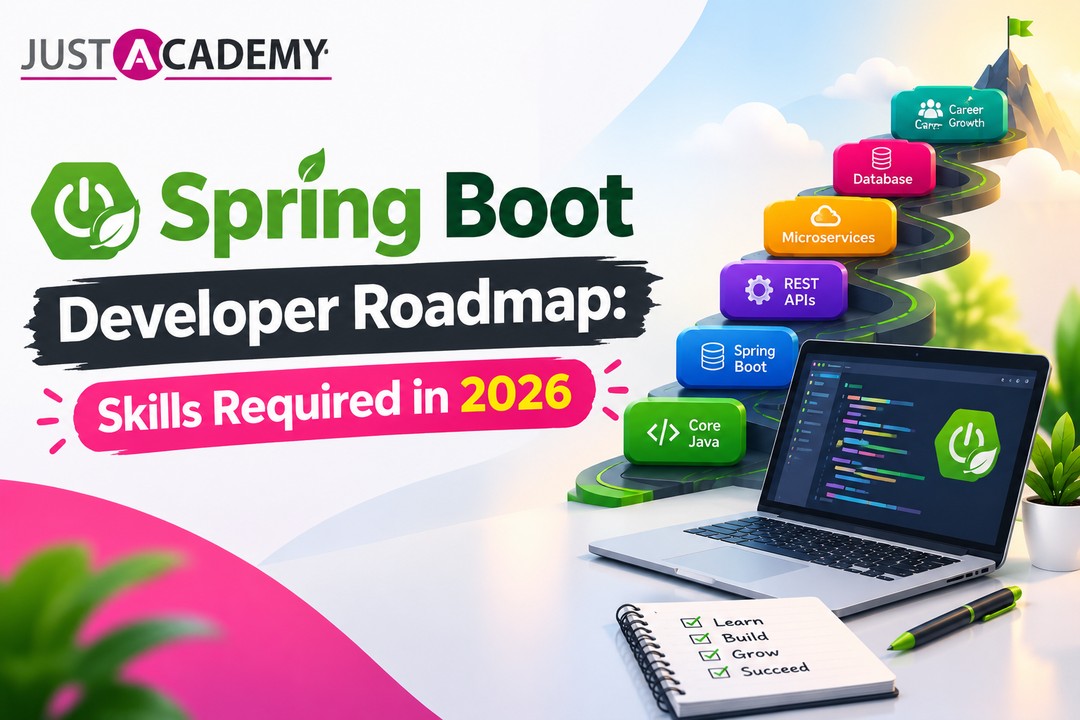
Before the details, here is the shape of the journey. First comes Java itself, including object oriented design, collections, streams and exception handling. Second comes the Spring Framework core ideas, namely dependency injection and the application context. Third is Spring Boot, where you build REST APIs quickly. Fourth is data, covering SQL, Hibernate and JPA, and later MongoDB. Fifth is security. Sixth is distributed systems with Spring Cloud and Kafka. Seventh is testing, containers and deployment. Eighth is portfolio and interview preparation.
A good spring boot developer roadmap for beginners is not a race through every tool. It is a ladder where each step makes the next one easier. Skip a rung and you feel it later, usually when a bug appears that you cannot explain because you never understood what the framework was doing behind the curtain.
Most beginners fail not because the content is too hard, but because they learn it out of order. They jump to microservices before they understand a simple controller, or they copy a security configuration without knowing what a filter chain is. The roadmap in this blog is deliberately sequenced so that you never have to unlearn something.
Spring Boot Compared With Other Backend Choices
Delhi has a vibrant mix of startups, product companies and large service firms, and each leans toward different stacks. It helps to see where Spring Boot sits among the alternatives.
Factor
Spring Boot (Java)
Node.js with Express
Django (Python)
Typical use
Enterprise systems, banking, large e-commerce
Real time apps, lightweight APIs, startups
Data heavy sites, rapid prototypes
Performance at scale
Very strong with mature tuning options
Strong for input output heavy loads
Good, with caching and scaling work
Learning curve
Steeper at first, rewarding later
Gentle for JavaScript developers
Gentle for Python developers
Ecosystem for microservices
Spring Cloud, Kafka, Resilience4j
Many libraries, less standardised
Fewer standard options
Hiring demand in enterprises
Very high
High
Moderate to high
Fresher friendly structure
Opinionated and consistent
Flexible, easy to write messy code
Opinionated and consistent
None of these choices is wrong. But if your goal is steady employment inside established companies, the data points toward Java. That is why the java spring boot jobs listings remain among the largest backend categories year after year.
The Foundation You Cannot Skip: Core Java Before Spring
Object Oriented Thinking That Actually Sticks
Many learners rush past this part because it feels basic. Please do not. Spring is, at its heart, a very clever collection of object oriented ideas. When you understand inheritance, interfaces, polymorphism and encapsulation properly, the framework stops feeling like magic and starts feeling logical. Dependency injection, for instance, is simply a disciplined use of interfaces and composition.
Try this exercise. Write a small program with an interface called PaymentService and two implementations, one for cards and one for UPI. Then write a class that uses PaymentService without knowing which implementation it receives. Congratulations, you have just built the idea behind Spring’s inversion of control, without any framework at all. Later, when Spring wires beans for you, you will understand why.
If you are still shaky on these concepts, the Core Java training is a sensible place to build that base before moving to framework work, and learners who want to go deeper into servlets, JDBC and web fundamentals can look at the Advance Java training.
Collections, Streams and Modern Java Features
Backend work is mostly about moving, shaping and filtering data. That is why collections and streams deserve real attention. You should be comfortable with List, Set and Map, know when a HashMap is a better choice than a TreeMap, and understand what happens inside when keys collide. You should be able to write a stream pipeline that filters orders, groups them by customer and sums the totals, and then explain it to someone else in plain words.
Modern Java also gives you records, sealed classes, switch expressions, text blocks and the Optional type. These are not decorations. Records make data transfer objects short and safe. Optional helps you avoid the null pointer exceptions that haunt junior code. Interviewers in Delhi and across India regularly test these topics, because they reveal whether a candidate learned Java recently or merely remembers an old syllabus.
Concurrency, Memory and Exceptions Without the Fear
Concurrency scares beginners, but you only need a clear mental model to start. Learn what a thread is, why shared mutable state causes bugs, and how executors, synchronized blocks and concurrent collections reduce the risk. Then learn the basics of how the JVM manages memory, including the heap, the stack and garbage collection, because production problems often come down to memory behaviour.
Exception handling deserves a calm study too. Know the difference between checked and unchecked exceptions, and learn to design meaningful custom exceptions. Later, when you build REST APIs, these same exceptions will be translated into clean error responses for clients. A developer who handles errors gracefully looks senior long before the title arrives.
Inside the Framework: Spring Boot Essentials Every Beginner Must Own
Dependency Injection, Beans and the Application Context
The Spring Framework revolves around a container that creates objects, wires them together and manages their lifecycle. You tell Spring what you need, and it hands it to you. Constructor injection is the style you should prefer, because it makes dependencies explicit and testing straightforward.
Spend time on annotations like Component, Service, Repository, Configuration and Bean. Learn what component scanning does and how profiles let you switch behaviour between development and production. When you understand these, you will read other people’s Spring code with confidence instead of confusion, and that skill alone separates a capable spring boot developer from someone who only copies snippets.
Building REST APIs the Way Teams Expect
Spring Boot removed the painful configuration of the old days. With starter dependencies and auto configuration, you can have a working web service running in minutes. But a working service is not the same as a well built one. A professional REST API uses proper HTTP verbs and status codes, validates incoming data, returns consistent error structures, supports pagination, and is documented with OpenAPI.
Build a project, not a demo. A library management system, a hospital appointment service or a small online store gives you real decisions to make. How do you design the endpoints? What happens when a book is already issued? How do you stop two users from booking the same slot? These questions teach more than any lecture, and they become the stories you tell in interviews.
When you reach the front end of your project, you will probably pair your backend with React or plain JavaScript. A solid grip on the language matters here, and this is where the JavaScript training in Delhi fits naturally, because a backend developer who can also read and write front end code is far more valuable to a small team. Pairing java spring react is one of the most requested combinations in full stack openings.
Configuration, Actuator and the Habits of Production Code
Real applications run in more than one environment, and secrets must never sit inside your source code. Learn to use application properties or YAML files, environment variables and externalised configuration. Learn how Actuator exposes health checks, metrics and info endpoints, and why operations teams love it.
Logging is another skill that beginners underestimate. Use SLF4J properly, log with meaningful context, and never print sensitive data. When something breaks at two in the morning, your logs will either save you or abandon you. Teams quietly judge junior developers by how they log and how they handle configuration, long before they judge them by clever algorithms.
Talking to Data: Hibernate, JPA, SQL and MongoDB
SQL First, Always
Almost every backend job requires strong SQL, and no framework can rescue you if you are weak here. Practise joins, grouping, subqueries, indexes and transactions. Understand normalisation and when to break it deliberately. Learn to read an execution plan so you can explain why a query is slow.
Many learners lean on the ORM too early and never learn what queries it generates. Then one day a page takes twelve seconds to load, and they have no idea why. If you know SQL, you can look at the generated statements and spot the problem in minutes. If you are also exploring analysis work alongside backend skills, learning Python gives you a handy second tool for scripting, reporting and data cleaning, and the Python training in Delhi is one route that complements Java well.
Hibernate and Spring Data JPA in Practice
The pairing of hibernate spring and Spring Data JPA lets you work with databases through Java objects. You define entities, map relationships such as one to many and many to many, and write repository interfaces that Spring implements for you. It feels wonderful at first, and then you meet the famous problems.
The N plus one query problem is the classic. You load a list of orders, and Hibernate quietly fires an extra query for every order’s customer. Learn lazy versus eager fetching, join fetch, entity graphs and projections. Learn how transactions work with the Transactional annotation, and why putting it in the wrong place causes strange behaviour. These topics appear in nearly every serious Spring interview, and the candidates who can explain them calmly stand out immediately.
MongoDB and the Case for Document Databases
Not every dataset fits neatly into tables. Product catalogues with varied attributes, activity feeds, content platforms and event logs often suit document databases better. Spring MongoDB support, delivered through Spring Data MongoDB, lets you use repositories and templates in a style very similar to JPA, so the learning curve is gentle once you know the basics.
The real skill is knowing when to choose which. Use relational databases when you need strong consistency, complex joins and transactions across entities, such as in payments and inventory. Consider MongoDB when your data shape changes often or when you read whole documents at once. Mention this trade off thoughtfully in an interview and you will sound like someone who has designed systems, not just followed tutorials. For high concurrency services, a java spring developer should also know the reactive options, including Spring WebFlux and reactive repositories, even if you use them selectively.
Guarding the Gates: Spring Security and Backend Safety
Authentication and Authorisation, Explained Plainly
Security often feels like a separate universe, but it is just a set of questions your application must answer on every request. Who are you? That is authentication. What are you allowed to do? That is authorisation. Spring Security answers both through a chain of filters that sit in front of your controllers.
Beginners are often told to disable security to make things work during development. Resist that habit. Instead, learn how the security filter chain is configured in modern Spring Security, how password hashing with BCrypt works, and how roles and authorities are checked. A developer who treats security as part of the design from day one avoids painful rewrites later.
JWT, OAuth2 and Single Sign On
Modern applications rarely rely on old style server sessions alone. Mobile apps, single page front ends and partner integrations need token based authentication. Learn how a JSON Web Token is structured, what the signature protects, why expiry matters and how refresh tokens work. Then learn the basics of OAuth2 and OpenID Connect so that you can integrate login through providers like Google or a company identity server.
In Delhi’s large service firms and product companies, you will often meet identity platforms such as Keycloak or enterprise single sign on systems. If you understand the flows conceptually, adapting to the tool is a matter of days, not months.
Everyday Defences Every Developer Should Know
Beyond login, a safe backend defends against common attacks. Understand SQL injection and why parameterised queries stop it. Understand cross site request forgery and cross origin resource sharing, and configure them deliberately rather than copying a permissive setting from the internet. Validate every input, limit request sizes, apply rate limiting and never expose internal stack traces to clients.
Security knowledge also shows up in testing. If you are drawn to the quality side of software, the Full Stack QA Automation bootcamp in Delhi is a useful look at how testers think about breaking the very systems developers build, and that mindset makes you a better developer too.
From One App to Many: Microservices, Spring Cloud and Kafka
Knowing When Microservices Make Sense
Microservices are fashionable, and fashion can be dangerous. Splitting a small application into ten services creates network failures, deployment complexity and debugging nightmares that a single well structured application would never have. Many experienced teams start with a modular monolith and split only when scale or team size demands it.
A mature spring boot developer understands this trade off and can say it aloud in an interview. You gain independent deployment, technology flexibility and fault isolation. You pay with distributed complexity, eventual consistency and operational overhead. Being honest about both sides is a sign of seniority, and interviewers notice it.
Spring Cloud, Resilience and Service Discovery
When you do build microservices, Spring Cloud provides the supporting pieces. An API gateway through Spring Cloud Gateway becomes the single entry point. Service discovery lets services find each other without hard coded addresses. Centralised configuration keeps settings consistent. Circuit breakers through Resilience4j stop one failing service from dragging down the rest, and retries with backoff handle temporary hiccups.
Distributed tracing and metrics are equally important, because when a request travels through six services, you need a way to follow it. Learn Micrometer, tracing concepts and how dashboards reveal bottlenecks. These skills are what teams mean when they say a candidate has real microservices experience rather than a certificate.
Kafka and Event Driven Design
Not every interaction should be a direct call. When an order is placed, you may need to update inventory, send an email, notify a warehouse and record analytics. Doing all that synchronously makes the user wait and ties services tightly together. With kafka spring integration through Spring for Apache Kafka, the order service simply publishes an event, and other services react in their own time.
Learn topics, partitions, consumer groups, offsets and delivery guarantees. Understand why idempotent consumers matter, because messages can be delivered more than once. Learn how dead letter topics catch poisonous messages. Event driven thinking is now part of everyday backend work, and it is a topic where good candidates separate themselves from average ones.
Shipping Your Work: Testing, DevOps and Kubernetes Basics
Testing That Gives You Confidence
Code that is not tested is code you are afraid to change. Learn unit testing with JUnit and Mockito, slice tests for controllers and repositories, and integration tests that start real dependencies using Testcontainers. Know the difference between a mock and a stub, and resist the temptation to mock everything until your tests prove nothing.
A healthy test suite is also a communication tool. Someone reading your tests should understand what the system promises to do. For a deeper look at how automated testing is organised on professional teams, this Selenium automation testing framework guide for beginners shows how layered test frameworks are designed, and the thinking carries over directly to backend test suites.
Docker, CI and the Delivery Pipeline
A developer who can only run code on their own laptop is only half useful. Learn to write a clean Dockerfile for a Spring Boot application, use multi stage builds to keep images small and run the container locally with Docker Compose alongside a database. Then learn continuous integration, where every commit triggers a build, tests and static checks automatically.
Tools like Git, GitHub Actions or Jenkins appear in almost every job description. You do not need to be a DevOps engineer, but you should be able to explain how your code travels from a commit to a running server. That fluency reassures employers that you will not need constant hand holding.
Spring Cloud Kubernetes and Running at Scale
Most large organisations now deploy to Kubernetes, and the idea of spring cloud kubernetes is to let Spring applications use native Kubernetes features such as config maps, secrets and service discovery. At the beginner stage, focus on the concepts: pods, deployments, services, readiness and liveness probes, and how Actuator health endpoints connect to them.
You do not need to master cluster administration in your first year. But understanding how your application behaves when it is restarted, scaled up or moved between nodes will make you a far more thoughtful developer. Write stateless services, handle shutdown gracefully and keep configuration outside the image. These habits make your code a pleasure to operate.
A Realistic Six Month Plan for Beginners
Month by Month Spring Boot Developer Roadmap for Beginners
People always ask how long all this takes. The honest answer depends on your starting point and your weekly hours, but a focused learner studying consistently with a mentor can reach job readiness in roughly six months. Here is a practical plan.
Month
Focus
What You Should Be Able to Do
1
Core Java, OOP, collections, streams
Write clean programs and explain object oriented design
2
SQL, JDBC, Spring core, dependency injection
Query databases confidently and explain how beans are wired
3
Spring Boot REST APIs, validation, exception handling
Build and document a complete CRUD service
4
JPA, Hibernate, MongoDB, Spring Security with JWT
Build a secured, data backed application
5
Microservices, Spring Cloud, Kafka, Docker
Split a project into services with messaging
6
Testing, CI, capstone project, interview practice
Present a deployed project and clear mock interviews
This is the same sequence you would see in a well designed spring boot developer roadmap for beginners, and it works because every month stands on the one before it.
Building a Portfolio That Gets Noticed
A portfolio beats a promise. Recruiters scanning dozens of profiles will remember the candidate with three solid, deployed projects over the one with ten certificates. Aim for a secured REST API with a clean README, a small microservices project using Kafka and a full stack application with a React front end.
Document your decisions. Write a short note about why you chose a relational database, how you handled authentication and what you would improve with more time. Even though some learners start their coding journey in another language, ideas from this guide on Python projects for beginners to build a developer portfolio apply here too, because the principle of showing finished, explainable work is universal.
Front End Companions Worth Learning
Even backend specialists benefit from basic front end ability. You will test your own APIs through a browser interface, collaborate with front end teammates and sometimes need to fix a small UI issue yourself. Learn modern JavaScript properly, including arrow functions, destructuring, promises and modules. This summary of JavaScript ES6 features every developer must know covers the essentials that make React code readable.
If you want practice material, these JavaScript projects every beginner should build for a portfolio give you concrete ideas to connect with your Spring Boot APIs. For styling, even a quick pass with Bootstrap can make a demo look professional, which is a simple way to make your work more convincing without spending weeks on design.
Your Spring Boot Career Map: Jobs, Freshers and Remote Roles
Spring Boot Jobs for Freshers
The good news for newcomers is that spring boot jobs for freshers exist in real numbers, particularly in service companies, consulting firms and growing product teams across Delhi, Gurugram and Noida. The bad news is that the competition is real too. Employers are tired of candidates who list Spring Boot on a resume but cannot explain what a bean is.
What freshers should show is clarity. Explain dependency injection in your own words. Walk through a project you built, including a bug you solved. Be ready to write a simple REST endpoint on a whiteboard or shared screen. Honest curiosity beats memorised definitions every time. Look for job titles such as junior Java developer, associate software engineer, backend trainee and Spring Boot developer, and apply broadly while you continue building.
Remote Spring Boot Developer Jobs and Global Openings
Remote work has opened a door that earlier generations of developers did not have. Remote spring boot developer jobs are now posted by companies in India, Europe, the Middle East and North America, and a java spring developer in Delhi can compete for them with the right skills and communication. Employers hiring remotely care a lot about written clarity, reliability and self management.
Practise writing clear pull request descriptions, documenting your code and communicating blockers early. Build a profile on professional networks, contribute to a small open source project and keep your project repositories tidy. For remote roles especially, your online presence is your first interview, so treat it with care.
Growing From Developer to Senior Engineer
A spring boot career does not stop at your first role. After a year or two, you can grow toward senior developer, tech lead or architect positions, or branch into specialisations like cloud engineering, performance engineering, security engineering or AI integration. Salaries tend to rise sharply with demonstrated depth, particularly for engineers who understand system design, cloud platforms and distributed systems.
The pattern among those who progress fastest is surprisingly consistent. They read other people’s code, they ask why systems are built a certain way, they volunteer for production issues and they keep learning in public. Technology changes, but curiosity compounds. Keep a small set of fundamentals sharp, and the new tools will arrive and fit around them.
If you are curious how a structured plan like this could look for you personally, you can book a free demo session and speak with a mentor about your background, your goals and a realistic timeline.
Why Structured Training Changes the Outcome
Live Interactive Sessions Versus Pre Recorded Content
Recorded tutorials are wonderful for revision, but they cannot answer your specific question at the exact moment you are stuck. Live interactive sessions can. When you are inside a class where an instructor writes code in real time, makes small mistakes on purpose and explains how to debug them, you learn a way of thinking, not just a list of commands. You can interrupt, ask why, see another learner’s question and hear the answer.
This is the heart of JustAcademy’s approach. Instructor led live classes keep you accountable, and mentor led sessions give you someone to review your project, challenge your design and prepare you for interviews. For learners in Delhi and across the NCR, the live online format removes the commute while keeping the human interaction that makes learning stick. It is the same live interactive training that students in classrooms receive, delivered to your screen.
Mumbai Classroom Training and Global Online Access
JustAcademy is an ISO certified technology training institute based in Mumbai, with branches in Mumbai and Pune and live interactive online courses available to learners across India and around the world. Many students see it as the best course in Mumbai for Java and backend careers, and the same teaching quality reaches Delhi learners through the online programmes.
Placement Support, Projects and Mentorship That Last
Skills win interviews, but guidance helps you reach them. Placement support at JustAcademy includes resume building, mock interviews, portfolio reviews and interview preparation aligned with what employers actually ask. Real projects in the curriculum mean that you graduate with evidence of your ability, not just a certificate.
Perhaps the most underrated benefit is the peer group. Learning alongside people with the same goal gives you motivation on tired days, new perspectives on tricky problems and a network that often turns into referrals later. Self study can get you far, but a structured, mentor guided environment makes the journey shorter, steadier and a lot less lonely.
Conclusion
The path to becoming a confident Spring Boot developer is not mysterious. It is a sequence: Java fundamentals, Spring core, REST APIs, data with SQL, Hibernate and MongoDB, security, microservices with Spring Cloud and Kafka, testing and deployment, and finally a portfolio that proves it all. These backend developer skills are in demand in Delhi, across India and in remote roles worldwide, and they will stay valuable as long as businesses need reliable, scalable software.
What separates people who finish from people who drift is rarely talent. It is structure, feedback and consistency. Choose a plan, build real projects, ask good questions and surround yourself with mentors who have walked the road before. Your first offer may take a few months, but the skills you build will serve you for an entire career.
A practical, human guide for Delhi freshers and working professionals who want to walk into every technical, design and HR round with real confidence, backed by live interactive, instructor led and mentor led sessions.
A practical, honest guide to frontend developer skills, the roadmap that actually works, and how live instructor led and mentor led training can get you hired
A practical, no fluff guide to the front end developer skills Delhi employers test for, and how mentor led, live interactive training helps you build them.
A practical, example driven guide to ES6 JavaScript for learners in Delhi who want to write modern code, think like a developer and get job ready with live instructor led and mentor led training
From your first Angular app to real time dashboards, here is a practical, mentor backed list of angular projects for practice, with source code thinking, live interactive sessions and placement support.
From a humble to do list to a Node JS backend, here are the javascript project ideas that actually teach you something and give recruiters a reason to click your GitHub link.
A straight talking guide for Delhi freshers, career switchers and non tech graduates on choosing the right IT certification, and why live interactive, instructor led and mentor led training makes the difference
Drop us a Query
+91 99871 84296
Available 24x7 for your queries
Want To Connect with us
🚀 Kickstart Your IT Career
with JustAcademy
Learn Industry-Focused Courses with Live Projects & Placement Assistance
Full Stack Java(Java, Spring Boot, Hibernate, REST API, React JS)
Data Analytics(Excel, SQL, Power BI, Python, Tableau)